Soulmate:
Where intentions meet forever
A production matrimonial platform — realtime chat, a complete interest → accept → connect matchmaking loop, a Razorpay-powered credit economy, and a 20-filter discovery engine, all on a single PostgreSQL backend.
email male1.user@example.com · password Password123!
TECHNICAL HIGHLIGHTS
Realtime Chat
Socket.io messaging with presence and multi-device sockets
Matchmaking Loop
Interest → accept → connect → chat state machine
Credits Economy
Razorpay top-ups + daily free-search/message allowance
Per-Request Discovery
20+ filters sent per search — change a filter, get new results
Correct by Construction
Idempotent payments, guarded credit spends, atomic writes
Notifications
In-app notification centre + Firebase push (FCM)
Visual Tour
Explore the platform's features through detailed screenshots.

Curated Discovery
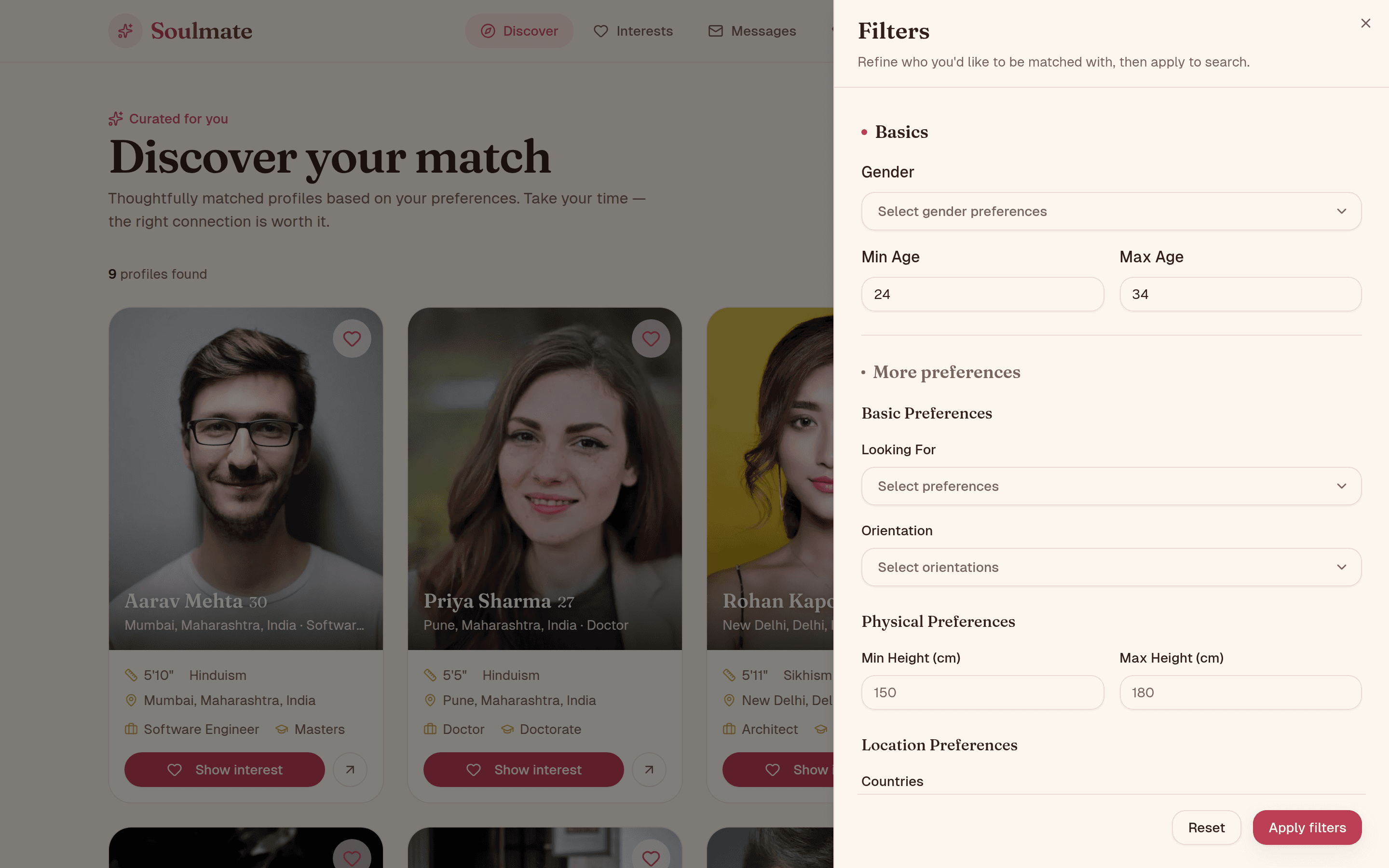
20-Filter Search Panel

Rich Match Profiles
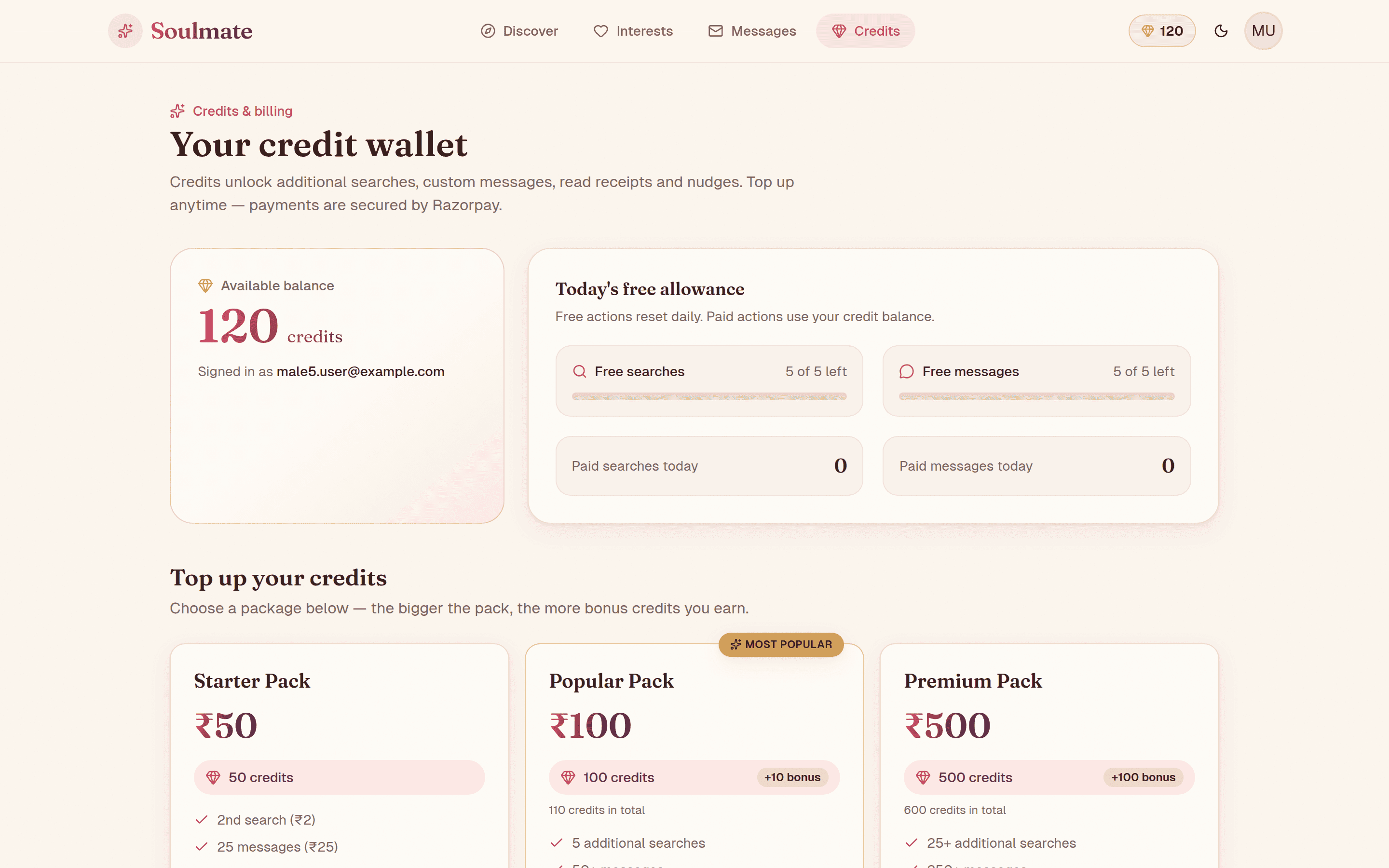
Razorpay Credit Wallet

Warm, Premium Landing
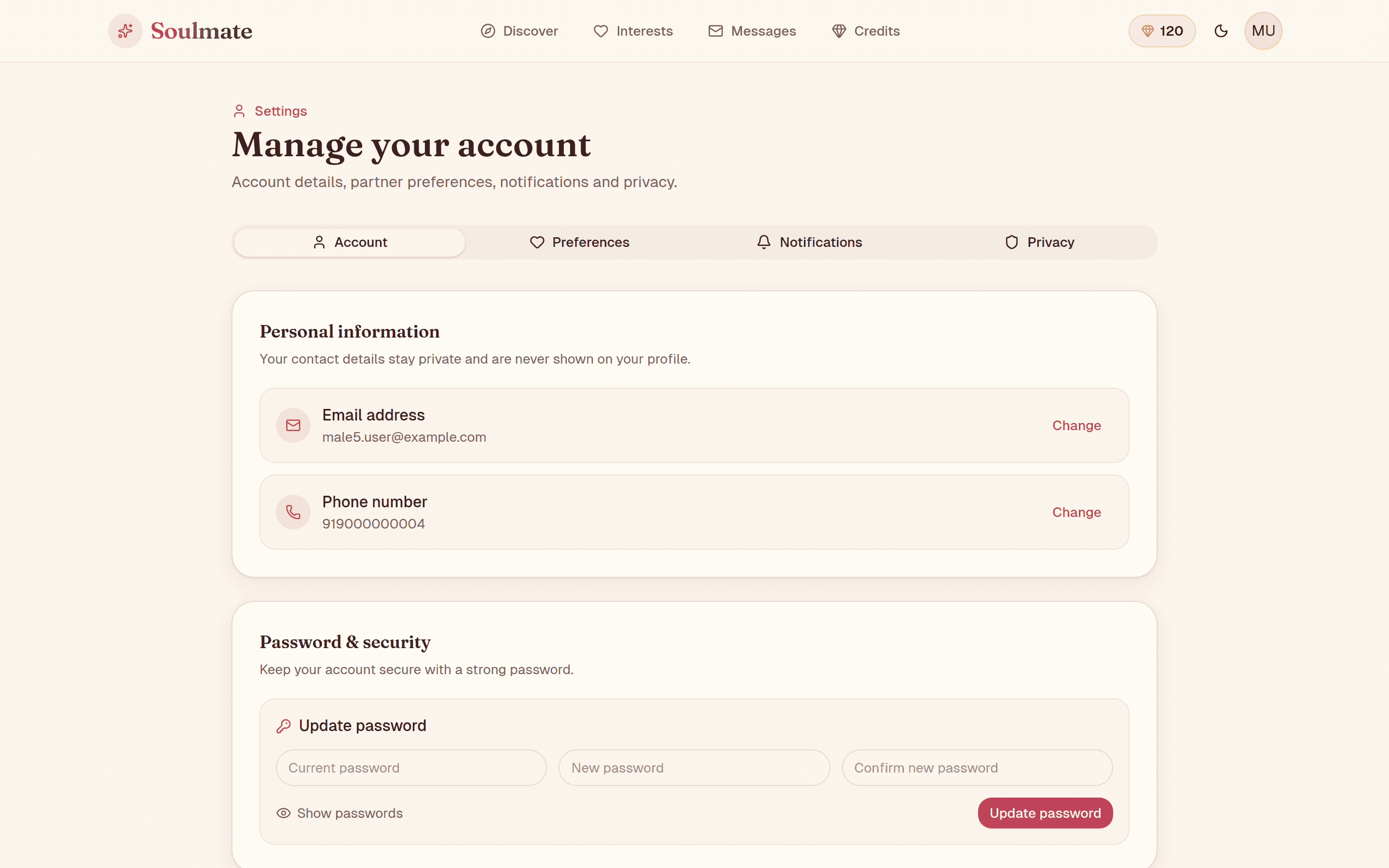
Account & Privacy
Correctness
The bugs that cost real money
Once an action costs a credit and a credit costs a rupee, a class of bug stops being cosmetic. A double-fired webhook is a free top-up. A retried request is a double charge. The pattern used throughout is to push these guarantees into the database schema, where they hold regardless of which code path arrived and how many times.
FOUR GUARANTEES
A payment can be credited at most once
A partial unique index on the transactions table covers gateway_transaction_id where the row is a credit and the id is not null. A replayed Razorpay webhook does not double-credit a wallet — not because the handler checks, but because the insert cannot succeed twice.
Interest is a unique pair, not an event log
matrimonial_connections is keyed unique on (requester, recipient). Sending interest is an upsert back to 'pending', so tapping the button twice cannot produce two requests, and the pair's state is one row rather than something reconstructed from history.
A webhook is verified before it is believed
The Razorpay signature is recomputed as an HMAC-SHA256 over the raw body and compared with crypto.timingSafeEqual rather than string equality, so the comparison does not leak information through how long it takes to fail.
Prices are validated against the ledger, not the request
A payment is checked against an allow-list of permitted rupee amounts and a permitted credits-per-rupee band before anything is written. A client asking for a thousand credits for one rupee is rejected on arithmetic, not on trust.
FIVE FRAUD CHECKS ON A SPEND
The detector returns a list of typed alerts rather than a boolean. Each carries a severity, a human description and an evidence object, so a flagged spend can be reviewed rather than only blocked — which matters because every one of these checks has false positives and a paying user hitting a silent wall is its own kind of failure.
The velocity check reads the last hour of debits and compares both cumulative amount and transaction count against thresholds set from what normal use on this platform looks like. The anomaly check reads thirty days of history to establish that baseline per user rather than globally.
Transactions record balance_before and balance_after as decimals, not floats. The ledger is reconstructable and it does not drift.
Discovery
A search you paid for stays paid for
If a search costs credits, showing someone the same twelve profiles twice is charging them twice for one result. So every profile surfaced to a user is written to a ledger table keyed unique on the pair of user and profile, and a search can ask to exclude everything already on it. Pagination is free and re-filtering is a fresh search — the boundary between the two is what the pricing hangs on.
What a user is looking for is itself a row. The saved-preference table carries twenty-seven criteria columns across partner basics, location, education and profession, lifestyle, family, and languages — most of them JSON arrays, because “any of these three religions” is a normal thing to want and a single-value column cannot express it. The search panel opens pre-filled from that row, so the default search is the one the user already described.
Free and paid tiers are configuration rather than code. A platform_limits row holds the daily free allowances and the price of each paid action — searches, messages, read receipts, nudges, unlocking a reply to an interest. Repricing the product is an update statement. Consumption is counted in a per-user, per-day row with a unique constraint on that pair, and a midnight cron closes off the previous day.
RATE LIMITS SCALE WITH WHAT A ROUTE COSTS
Three global tiers apply to everything — 12 requests a second, 80 in ten seconds, 400 a minute — which is a burst guard, not a security control. The routes where abuse is actually expensive override it, and the limits get much tighter the closer a route gets to sending mail, creating an account, or moving money.
Email OTP resend
2 per 10 minutes
Password reset request
3 per hour
Register
3 per minute
Login
5 per minute
Spend credits
10 per minute
Profile search
12 per 6 seconds
Two per ten minutes on an OTP resend is deliberately frustrating. It is also the difference between an email-sending endpoint and a free spam relay, and it is the kind of limit that has to be set before it is needed rather than after.
Caching is optional by design. Redis is used when a URL is configured, with TLS forced for managed hosts and connection errors logged rather than allowed to take the process down; with no Redis configured the app falls back to an in-memory store and boots normally. A cache outage is a slower platform, not an unavailable one.
The loop
Interest, accepted, then a conversation
Twenty-five Drizzle tables sit behind this, but the product is really one state machine: a connection row between two users that is pending, accepted or declined, and a set of capabilities that unlock at each step. A profile page reads that row and changes what its action bar even offers — Show Interest before, Message after. Accepting stamps a response time and fires a notification that says in as many words that the two of them can now message each other.
Blocking is checked in both directions before any of it. A block by either party removes the other from discovery and closes the connection path, which is a single bidirectional check rather than a rule each feature has to remember to apply. Contact details are never on a profile at any state — the product is built so that reaching someone is always mediated by the platform, which is both a safety property and the thing the credit economy is attached to.
Chat runs as a Socket.IO gateway inside the same NestJS process rather than as a separate realtime service — one deployment, one auth path, one database connection pool. Devices register FCM tokens over that same socket, so a message delivers to an open tab if there is one and to a push notification if there is not, without the sending code branching on which.
TECHNOLOGY STACK
frontend
Next.js 15
App Router, React 19
TypeScript
Type-safe end to end
Tailwind CSS v4
Warm, custom design system
shadcn / Radix UI
Accessible primitives
TanStack Query
Server-state & caching
Zustand
Client/realtime state
Socket.io client
Realtime chat & presence
backend
NestJS 11
Modular, guarded API
Drizzle ORM
Single PostgreSQL, typed SQL
PostgreSQL
One consolidated database
JWT Auth
Sessions + refresh tokens
Socket.io Gateway
Chat on the main server
Razorpay
Payments & webhooks
Cloudinary / Redis
Media + Upstash cache
devops
Render
Backend hosting
Vercel
Frontend hosting
Firebase FCM
Push notifications
drizzle-kit push
Schema reconciled on deploy